
Musing on a Crazy World
Socrates:
An unexamined life is not worth living
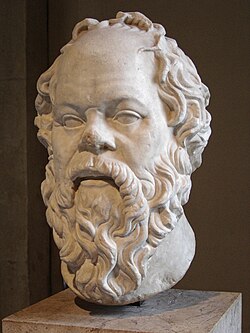
“I know that I know nothing".
Socrates (470BC – 399BC)
Socrates’ most enduring claim is simple and still awkward: an unexamined life is not worth living. He did not mean that everyone must become a professional philosopher. He meant that most of us move through our days treating our strongest opinions as settled facts, and that this habit is more costly than it first appears.
In Athens he spent his time asking people who were sure of themselves—politicians, craftsmen, poets—to explain the beliefs they lived by. What is justice? What is courage? What do you actually know, and how do you know it? The conversations rarely ended with a neat answer. More often they ended with the recognition that the speaker had been relying on something they could not clearly defend. Socrates treated that recognition as progress rather than defeat. The person who discovers the limits of their own understanding is, on his view, better placed than the person who never notices those limits.
That practice still cuts against ordinary modern habits. We are surrounded by systems that reward speed and certainty: a post that takes a clear side, a headline that settles a complex question in one sentence, a recommendation that arrives already shaped by what we have previously liked. These tools are efficient. They are also very good at letting us skip the slower step of testing whether our view still holds once someone asks an ordinary follow-up question. Socrates’ method does not require rejecting those tools. It requires noticing when we have stopped asking the next question because the current answer feels comfortable enough.
His own life supplied a concrete test of the idea. When the Athenian democracy charged him with corrupting the young and not believing in the city’s gods, he refused both to flatter the jury and to escape after the verdict. He treated the trial as another conversation in which he would not pretend to know things he did not know or abandon the standard he had already accepted. The outcome was his death. The point he left is narrower than a call to martyrdom: once you have examined a commitment and still hold it, you have reasons to keep it even when it becomes inconvenient. Most of us will never face a capital charge for asking questions. We do face smaller, more frequent versions of the same choice—whether to keep a view because it has survived some pressure, or because questioning it would cost us ease, status, or the approval of the people around us.
The practical residue is modest. When a claim feels especially obvious, or when an argument ends as soon as it becomes awkward, that is often the moment worth one more question rather than one more assertion. Socrates did not promise that the questions would produce certainty. He suggested only that the alternative—living entirely inside opinions we have never pressed—is a thinner way to spend the time we have.
What’s Been on Your Mind?
Every perspective adds something to the story. Share what this post brought to mind, or keep reading for another take on the little things that make up a life.